AL.FESTIVAL | Baadia Bouhrizi
- Downtempo
- Electronic
- Talk Show
Loading
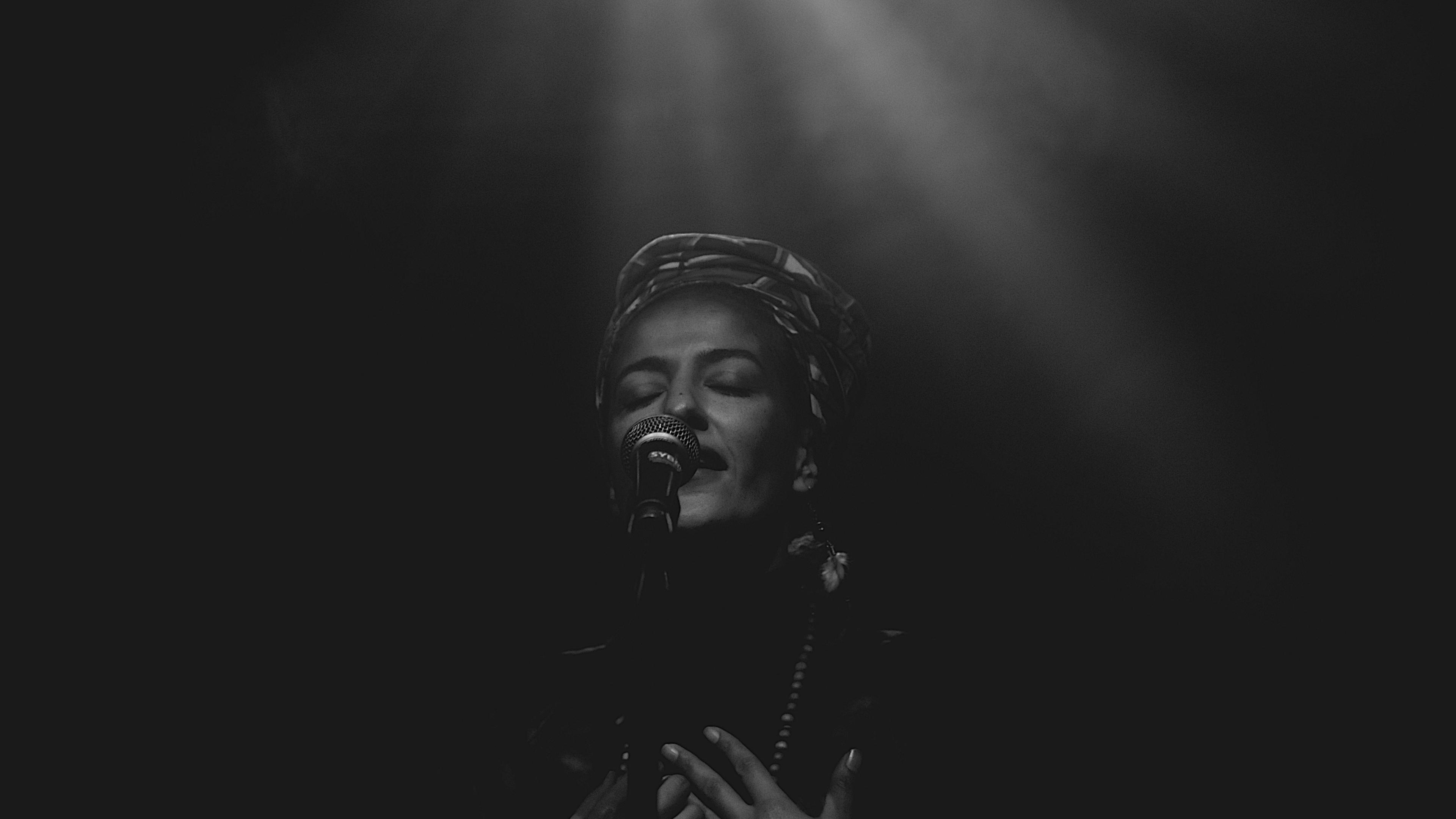
Singer-songwriter Badiâa Bouhrizi should really be a household name in global music circles. Jane Cornwell, Songlines. Her work is a bridge between worlds, a celebration of art as both beauty and conscience.
“In these times of uncertainty, there is only a small number of indisputable evidence: the profound reformulation of this taxonomy that has been called world music and the fact that in Africa, from the Maghreb to Le Cap, it is women who present the most subversive musical scene. And I won't say the most prolific too, even if it probably is [...] That of the Tunisian Badiâa Bouhrizi without going any further, represents – with other female performers – the new musical look of North Africa. [...] The fact is that Badiâa Bouhrizi, is not only an exceptional singer, but is also an inspired composer who brings together with talent and delicacy the Arab roots with the musical scents of other latitudes. But don't get me wrong: when she plays with electronic musicians, in duet with a violinist or accompanied by a group with electric guitars, keyboards and drums, for example, she does not fit into the bottomless box of the "fusion" but she creates new codes in which the ancestral merges with the contemporary and what is topical is tinged with classicism. In this quasi-astral conjunction of south and north resides the committed beauty of Badiâa Bouhrizi, a non-shooting star in an expanding universe (Javier Losilla, cultural journalist and music critic).
The Tunisian Badiâa Bouhrizi dreams, sings, composes and defends through Fusha Arabic. In her own words, her music comes from the heart, drawing on African, Arab and Mediterranean traditions, to claim her roots in every note. Her creations, with her soft and subtle voice, but also powerful, become a song of freedom with committed lyrics and verses. At the age of seven, Badiâa began as a soloist in a local choir in Tunis and later joined the Tahar Haddad choir, dedicated to classical Arabic music forms such as Andalusian Muwashah and North African Malouf. She moved from classical Arabic music to Rock with the Tunisian rock band Black Angels and later the free improvisation band Kheprae, as well as the ethno-rock band Dayrib. During her musicology studies in Paris, she began to experiment with a wide range of musical genres (jazz, soul, chanson) and to explore her roots (Amazigh music and African music), to find, over time, her own voice and synthesizes it towards a minimalist style in her compositions, thus sculpting her new sound universe. Badiaa Bouhrizi has collaborated with musicians of very different nationalities and styles: among others, the Indian Music band Shishya in Paris, French composer Nicolas Peigney, the London Afrobeat band Awalé, the German percussionist David Kuckhermann, the English Dub producer Adrian Sherwood, the Egyptian Fathy Salama, or Youssou N'Dour. After more than a decade dedicated to composing and producing music, Badiâa continues to share her music on stage, captivating the public in each of her concerts. Having been banned for a long time from playing in Tunisia because of her lyrics committed to a resistant political discourse, the Tunisians added to her name the word miltazema (militant in Arabic), a term attributed to artists who campaign for freedom and justice. She represents the independent Tunisian music scene, within which she claims the value of her cultural, hybrid, and multiple identity. Badiâa Bouhrizi is a musical experience and a voice that does not want to be reduced to the qualifiers of "traditional" or "fusion music", but rather wants to be the expression of an authentic, instinctive and contemporary music of the social reality she inhabits, preserving it from all futile rhetoric. Artist of the year of Songlines MAgazine 2024, awardee of the prestigious Aga Khan Music Award in the category of Social Inclusion in 2019 and the African Union of Cambridge University for Innovation in African Music in 2014, as part of the Africa Together event, which recognized her work as a singer and composer. Her music has crossed the borders of Tunisia to reach Great Britain, France, Spain, Canada, Italy, Lebanon, Mexico, Guatemala, Panama, Morocco, Jordan, Egypt, Colombia, and Germany, to name only a few.